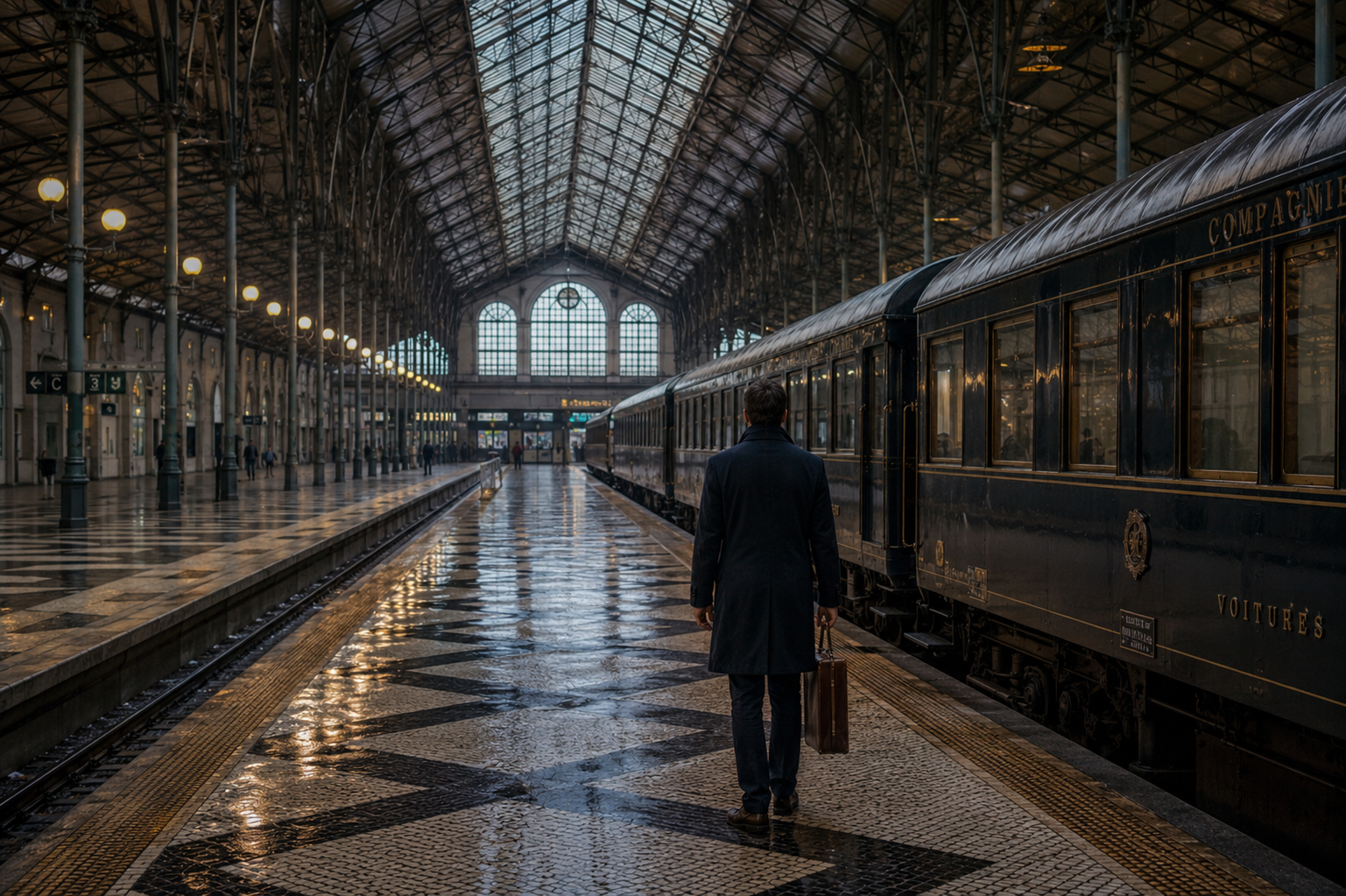

Florence changed completely after midnight.
The tourists disappeared first. Then the conversations dissolved from the piazzas one table at a time until only the practical sounds of the city remained — metal shutters lowering, distant dishes being stacked behind café doors, the uneven hum of a scooter crossing wet stone somewhere beyond Piazza Santa Croce.
The rain had ended less than an hour earlier.
Water still gathered along the edges of the narrow streets, reflecting fragments of amber streetlights beneath Renaissance facades darkened by moisture. Wooden shutters looked heavier in the damp air. Marble walls absorbed the night differently after rainfall, turning pale surfaces into muted grey-blue planes beneath the lamps.
The Arno moved quietly beside the sleeping city. Not dramatic. Not cinematic in any obvious sense. Just slow black water carrying trembling reflections beneath the bridges.
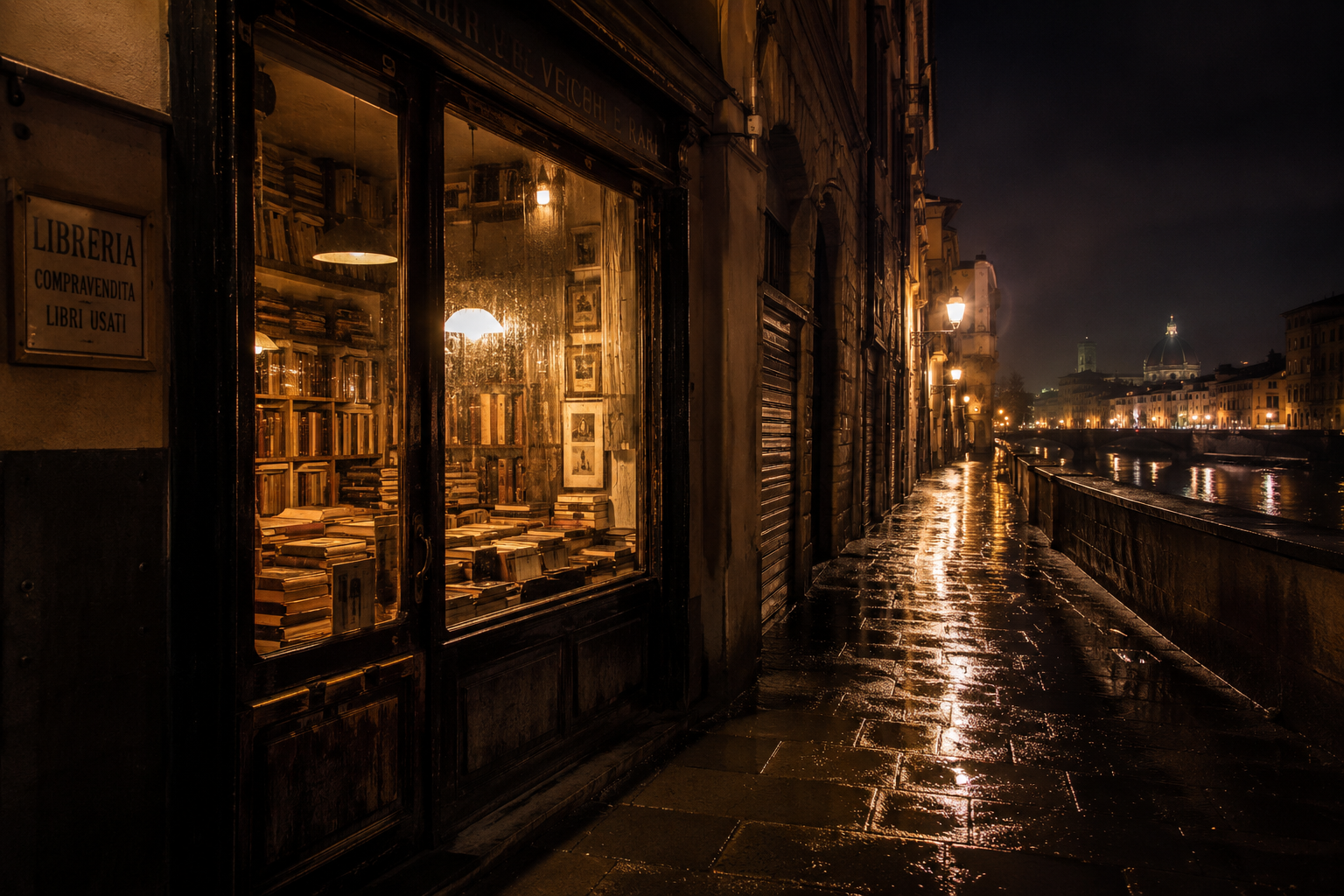
Near the river, tucked between a leather workshop and a watch repair shop already closed for the night, there was a bookstore small enough to miss entirely during the day.
Its sign had almost faded away.
Only the warm light inside distinguished it from the darkness around it.
The window glass carried thin streaks from the recent rain. Behind it, shelves leaned under the weight of old books swollen slightly by years of river humidity. The room glowed in muted amber tones that softened the edges of everything inside.
You entered mostly because the light felt human.
The floorboards creaked immediately beneath your shoes. Somewhere deeper inside the shop, a small radio played low jazz interrupted occasionally by static. The smell was unmistakable: damp paper, dust, old glue, fabric that had absorbed decades of tobacco smoke.
The owner barely acknowledged you.
He sat behind a wooden desk repairing the spine of a hardbound book beneath a brass lamp. Grey sweater. Reading glasses low on his nose. Slow deliberate hands moving with the concentration of someone performing maintenance on something alive.
Outside, water dripped rhythmically from a broken gutter.
The shop itself felt less like a business than a storage place for abandoned time.
Italian editions of Russian novels sat unevenly beside architecture monographs and old poetry collections. Some books contained folded corners or handwritten notes. Others carried fading price marks in pencil from decades earlier.
Nothing had been curated for presentation.
That was what made the place convincing.
Near the back shelf, partially hidden beneath a stack of art restoration catalogues, there was a small clothbound volume without a dust jacket. The fabric cover had worn smooth near the edges. Inside the front page, someone had written a date in blue ink:
October 1978
No signature. No message. Only the date.
Yet the handwriting altered the entire weight of the object.
Suddenly another person occupied the room.
Not physically, but materially — through fingerprints absorbed into paper fibers, through folded corners, through the slight darkening of pages repeatedly touched by someone decades earlier.
The realization arrived quietly.
Memory survives longest inside ordinary things.
Not monuments carefully preserved behind ropes. Not official histories engraved into marble plaques. Real memory remained elsewhere — inside receipts forgotten between pages, cracked leather chairs in cafés, fading photographs taped behind counters, old bookstores that still repaired bindings by hand after midnight.
The owner eventually stood and adjusted the lamp near the entrance. For a brief moment, the window reflected both the interior and the wet Florence street outside simultaneously. Shelves floated across rain-dark stone. Passing headlights dissolved briefly through old paperbacks.
The city felt layered over itself.
A couple passed outside beneath a shared umbrella without speaking. Their footsteps softened immediately against the wet pavement before disappearing toward the river.
The owner returned to his desk and continued repairing the damaged spine.
Thread through paper.
Glue pressed carefully against cloth.
Small acts against disappearance.
The radiator beneath the shelves clicked occasionally. Somewhere above the ceiling pipes shifted softly inside the walls. The radio lost signal for a moment before returning to muted jazz.
Nothing important happened.
And yet the room carried the quiet intensity of places where people have spent years protecting things that no longer generate urgency for the rest of the world.
Outside, Florence continued sleeping beneath the damp Renaissance facades.
The cathedral dome still dominated the skyline somewhere beyond the narrow streets, but here near the Arno the city felt smaller, more fragile, almost domestic. Light escaped from scattered apartment windows above shuttered storefronts. Someone washing dishes. Someone unable to sleep. Someone reading beside a lamp.
You stayed longer than intended without buying anything.
Not because of the books themselves, but because the room preserved a slower relationship with time — one almost impossible to encounter elsewhere now.
Eventually you stepped back outside.
The rain smell still lingered in the stone. The river carried fractured reflections beneath Ponte alle Grazie. Cold night air moved softly through the narrow streets.
Behind you, the bookstore remained illuminated against the darkened row of buildings.
Small. Quiet. Nearly invisible.
Yet somehow more permanent than many of the grander things Florence was famous for.
Because memory rarely survives through spectacle.
It survives through repetition.
Someone reopening a bookstore every evening beside the river.
Someone repairing damaged pages after midnight.
Someone leaving a warm light on long after the rain has ended.